About This Project
🧠 Personal Digital Studio
Building a Living Archive Instead of a Static Portfolio
🌐 Overview
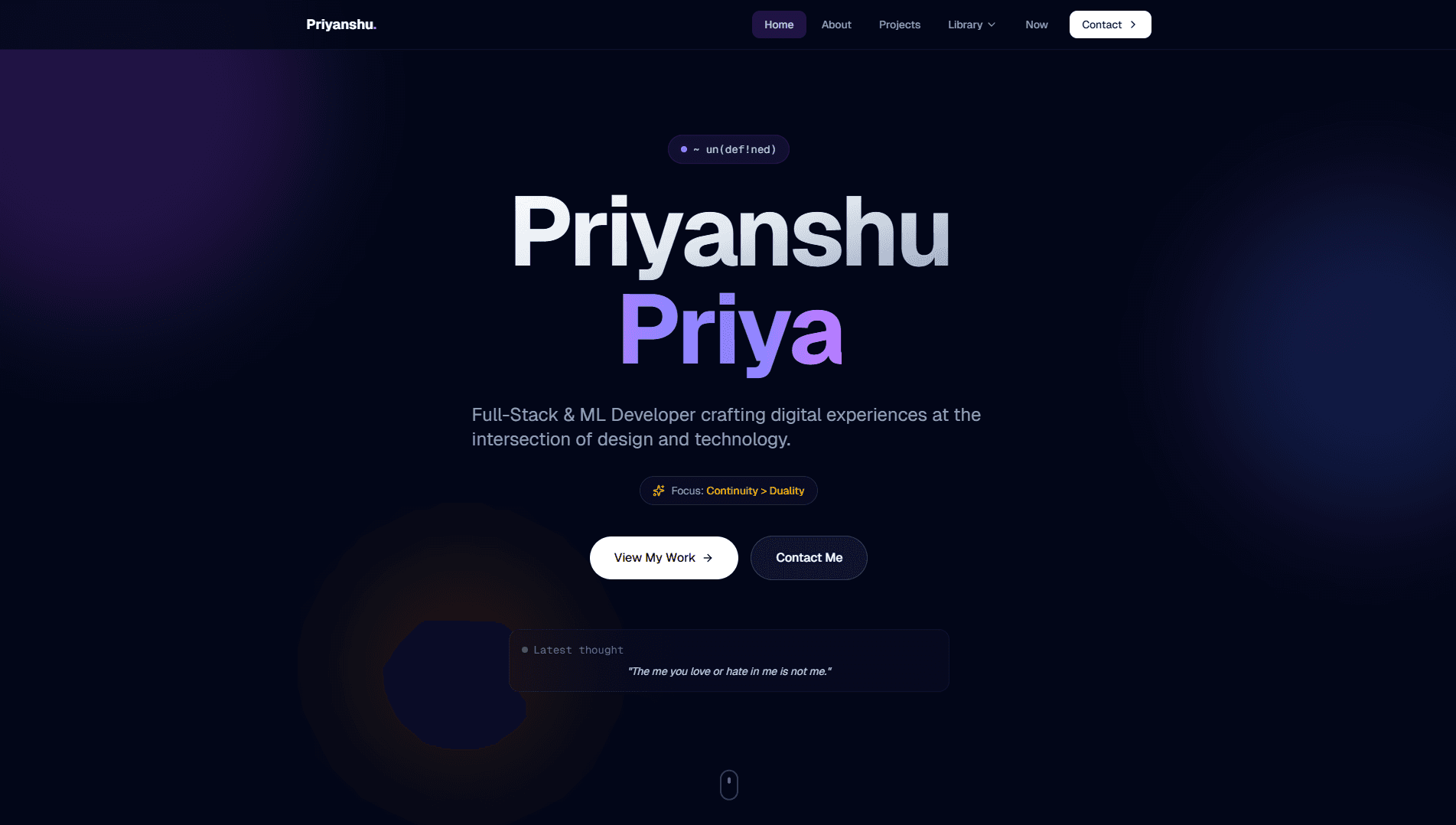
The Personal Digital Studio is a modern, full-stack personal platform designed to document projects, ideas, writing, and intellectual influences in one cohesive ecosystem.
Unlike traditional portfolios that remain static and outdated over time, this platform functions as a living knowledge archive — continuously evolving alongside my learning journey, creative output, and technical growth.
The project was built with a focus on:
- Ownership of content and infrastructure
- Editorial-quality reading and browsing experience
- Scalable content architecture
- Seamless developer-focused CMS integration
- Long-term extensibility
This platform represents not only my work but also how I think, learn, and build.
🎯 Motivation Behind the Project
Most developer portfolios are snapshots — they showcase completed work but rarely capture the thought process, learning journey, or evolving interests behind it.
As my projects, readings, and experiments increased, I needed:
- A centralized space to document technical work
- A system to publish long-form and short-form content
- A platform to curate external knowledge and influences
- A flexible structure that grows with time
- Full control over design, data, and publishing workflow
This project was created to solve those needs while maintaining professional presentation standards.
✨ Core Features
🏠 Dynamic Home Experience
The homepage acts as a real-time summary of current work and priorities.
Features include:
- Animated hero section with personal introduction
- Featured projects displayed using a responsive bento grid layout
- Infinite scrolling technology stack showcase
- Latest content snippets across blog, thoughts, and resonance
- Integrated contact form for direct communication
The homepage is designed to be adaptive, allowing content sections to be reordered dynamically through the CMS dashboard.
📂 Projects Showcase
The Projects module highlights technical and creative work using a structured case-study format.
Key capabilities:
- Chronologically sorted project listings
- Featured project highlighting
- Dedicated project detail pages
- Status tracking (Working On, Completed, Archived)
- Tech stack tagging
- External links for GitHub repositories, live demos, and documentation
- Previous/Next navigation between projects
Each project page focuses on storytelling — explaining not only what was built, but why it was built and what was learned.
📚 Multi-Format Content Library
The platform supports three distinct content categories:
📝 Blog
Long-form technical and reflective articles written using MDX.
Includes:
- Syntax highlighting for code blocks
- Mathematical notation support
- Structured editorial formatting
- Cover images and tagging system
💭 Thoughts
A micro-blogging system designed for quick insights and spontaneous reflections.
Features:
- Mood tagging system
- Lightweight publishing workflow
- Chronological feed display
🔗 Resonance
A curated knowledge archive containing books, articles, tools, and resources that influence my thinking and development approach.
Each entry includes:
- Commentary and personal reflections
- Resonance scoring system
- Categorization for discoverability
👤 About & Now Pages
These pages provide context about my professional journey and current focus.
About Page
- Background and academic journey
- Skills and technologies overview
- Personal philosophy and development approach
- Social and professional links
Now Page
Inspired by the "Now Page" movement, this section highlights:
- Current learning goals
- Active projects
- Short-term focus areas
- Recent updates and thoughts
📞 Contact System
The contact module ensures reliable communication and message tracking.
When a visitor submits a message:
- The data is securely stored in the database.
- A real-time email notification is sent to me.
The same reusable form component is used across:
- Homepage contact section
- Dedicated contact page
🛠 Admin CMS Dashboard
One of the most technically significant aspects of this project is the custom-built CMS dashboard.
It allows full control over the platform without modifying code.
Dashboard Capabilities
- Page content editing via structured JSON
- Full CRUD operations for projects
- Draft and publish workflow for blog posts and thoughts
- Resonance resource management
- Global configuration editing (navigation, SEO, social links)
- Drag-and-drop homepage section reordering
The dashboard ensures scalability while maintaining content consistency.
🧩 Technical Architecture
⚙️ Frontend
- Next.js (App Router) – Server-side rendering and optimized routing
- TypeScript – Type-safe and scalable codebase
- Tailwind CSS – Utility-first styling system
- Framer Motion – Smooth animations and UI transitions
- shadcn/ui + Radix UI – Accessible and composable UI components
- Lucide Icons – Lightweight icon system
🗄 Backend & Infrastructure
- Supabase PostgreSQL Database
- Supabase Authentication
- Supabase Storage for media handling
- Row Level Security (RLS) for secure data access
✉️ Communication Services
- Resend API for transactional email notifications
📄 Content Handling
- MDX Integration for blog and rich content publishing
- Structured database schema for dynamic content rendering
🚀 Deployment
- Hosted on Vercel
- Automatic CI/CD deployment pipeline
- Edge optimization for global performance
📁 Project Structure Highlights
The project follows a modular and scalable architecture:
- Public routes separated from dashboard routes
- Component-driven UI architecture
- Centralized Supabase client utilities
- Type-safe content schemas
- Hybrid static + dynamic content rendering
🔐 Security Considerations
- Row Level Security implemented across all database tables
- Protected dashboard routes via authentication
- Environment-based API key management
- Secure form submission handling
📊 Key Design Principles
Content-First Experience
Interface decisions prioritize readability and comprehension.
Editorial UI Philosophy
Minimal distractions, structured typography, and thoughtful spacing.
Long-Term Scalability
The architecture supports adding new content modules without major restructuring.
Ownership & Flexibility
Avoidance of third-party CMS limitations ensures complete control over data and design.
📈 Future Improvements
Planned enhancements include:
- Advanced search and filtering across content
- Analytics integration for content insights
- Commenting and engagement features
- Content recommendation engine
- Notification system for updates
- Multi-theme support
🧠 Key Learnings From the Project
- Designing scalable CMS architecture
- Implementing database security using RLS
- Managing hybrid content rendering with MDX
- Building reusable UI systems
- Structuring content-driven web applications
- Integrating transactional email workflows
- Designing long-term maintainable frontend architecture
🌍 Impact & Purpose
This project is not only a portfolio but a reflection of continuous learning and experimentation.
It serves as:
- A professional showcase platform
- A personal knowledge management system
- A long-term digital archive
- An experimental playground for design and architecture ideas
🔗 Links
-
🌐 Live Website:
https://priyanshupriya.vercel.app/ -
📄 Project Description:
https://priyanshupriya.vercel.app/work/projects/personal-digital-studio -
💻 GitHub Repository:
https://github.com/Priyanshu-Priya/personal-website -
📫 Contact & Collaboration:
priyanshupriyacodes@gmail.com
❤️ Final Note
This platform represents a shift from presenting finished work to documenting growth, exploration, and thought processes.
It is designed to evolve — just like the developer building it.